In a letter to European Voice CAP campaigner Terry Wynn MEP points out that little information is made available on who gets the large sums of money spent on CAP. Only Denmark, the UK, Estonia, Sweden and Slovenia (now joined by Belgium) make the information available.
When it is made available, it is quite revealing. Wynn points out that UK figures show that Lincolnshire receives three times more in agricultural subsidies than the north-west of England combined and has only a third of the number of farms. He points out that there is no disclosure of where the money goes in France despite the fact that it receives a quarter of CAP expenditure.
The Belgian payment agency, BIRB, has now posted details of the recepients of CAP money. At the top of the list is the sugar refinery in Tienen which received €91.9 million in 2004. At the bottom is the Sacred Heart pyschiatric hospital in Ypres which received €148.70.
There was considerable political resistance to the publication of the information. The agriculture minister in the federal government is Sabine Laruelle, a Walloon Liberal, who happens to be a former president of the Walloon farmers' union. She said she would not release names and amounts and that what was happening 'leads only to a witch hunt', pointing out that 'People focus on examples such as the Queen of England.'
Meanwhile, Yves Leterme, the Christian Democrat head of the Flemish regional government complained about efforts by commissioners Fischer Boel and Slim Kallas (audit and anti-fraud) to get national governments to disclose who gets what from the CAP regime. Leterme said that if the Commissioners were minded to make statements 'which intrude against our constitutional rights to the protection of privacy, then they had better keep their mouths shut.' However, Belgian prime minister Guy Verhofstadt decided in favour of disclosure.
This is public money and EU citizens are entitled to know where it is going. Publication may also serve as a deterrent to fraud which remains a persistent problem in the CAP.Any source
Sunday, November 6, 2005

Tuesday, November 1, 2005
Group opposed to sugar reform grows
Poland has joined the eleven countries led by Spain who are opposed to the Commission's proposals for reform of the sugar regime. Just four of the opposing countries - Greece, Italy, Poland and Spain - would be enough to block reform under the qualified majority system.
This latest development is causing concern in the Commission and the UK presidency. The WTO has declared the current regime illegal and the current regulation expires next June which would lead to chaos if nothing is put in its place.
The Commission has to think of some way of buying off opposition without rendering the whole reform pointless. The opposing states are calling for smaller price cuts over a longer period with more compensation and it is difficult to see how this can be squared with the WTO judgement or the EU budget.
It might be possible to include the option of partial decoupling for states such as Italy who feel they are worst hit by the price reduction, although it is questionable whether keeping small Italian sugar producers in business is compatible with the spirit of the reform. Certainly national compensation envelopes for sugar producers are still under consideration, but the sweetener would have to be significant.
A further complicating factor is that the opposition countries are suggesting that cuts should be applied initially just to regions with a surplus of production. If one interprets that as countries with B quotas, leading sugar producers would be hit, notably France and Germany where up to 20 per cent of overall production quotas are B quotas.
So this is all about winners and losers rather than a rational reform strategy that would be helpful for the EU as a whole. As June approaches, no doubt some sort of reform, with more side payments, will be devised.Any source
This latest development is causing concern in the Commission and the UK presidency. The WTO has declared the current regime illegal and the current regulation expires next June which would lead to chaos if nothing is put in its place.
The Commission has to think of some way of buying off opposition without rendering the whole reform pointless. The opposing states are calling for smaller price cuts over a longer period with more compensation and it is difficult to see how this can be squared with the WTO judgement or the EU budget.
It might be possible to include the option of partial decoupling for states such as Italy who feel they are worst hit by the price reduction, although it is questionable whether keeping small Italian sugar producers in business is compatible with the spirit of the reform. Certainly national compensation envelopes for sugar producers are still under consideration, but the sweetener would have to be significant.
A further complicating factor is that the opposition countries are suggesting that cuts should be applied initially just to regions with a surplus of production. If one interprets that as countries with B quotas, leading sugar producers would be hit, notably France and Germany where up to 20 per cent of overall production quotas are B quotas.
So this is all about winners and losers rather than a rational reform strategy that would be helpful for the EU as a whole. As June approaches, no doubt some sort of reform, with more side payments, will be devised.Any source
Bulgaria, Romania accession in trouble
Preparations for integration into the CAP remain 'areas of serious concern' for both Bulgaria and Romania just fourteen months away from their planned accession to the EU. To those who say cynically 'we have been here before', noting that outstanding problems when ten member states joined were glossed over, two points need to be borne in mind:
1. The EU is a much less confident and ferbile state following the effective failure of the Constitution
2. The problems with Bulgaria and Romania are more serious than those in the earlier wave of East European entrants.
Food safety is a major area of concern, with the Commission noting deficiencies in both countries in terms of animal disease control and regulations relating to BSE. Romania has made a little more progress in some areas, but both countries have failed to make progress in setting up an Integrated Administration and Control System.
The tone of the Commission report suggests that the warnings issued may be more than the usual routine pleas to get a move on. The situation is to be reviewed in April/May of next year when the postponement of accession by one year may be recommended.Any source
1. The EU is a much less confident and ferbile state following the effective failure of the Constitution
2. The problems with Bulgaria and Romania are more serious than those in the earlier wave of East European entrants.
Food safety is a major area of concern, with the Commission noting deficiencies in both countries in terms of animal disease control and regulations relating to BSE. Romania has made a little more progress in some areas, but both countries have failed to make progress in setting up an Integrated Administration and Control System.
The tone of the Commission report suggests that the warnings issued may be more than the usual routine pleas to get a move on. The situation is to be reviewed in April/May of next year when the postponement of accession by one year may be recommended.Any source
Sunday, October 30, 2005
French play food securirty card
Peter Mandelson is caught between a rock and a hard place in trying to reach agreement in the Doha Round agricultural trade negotiations. On the one hand, he has to move towards the negotiating demands of the US (and the G-20). On the other, he has to avoid annoying France so much that it derails the whole negotiation and hence the Doha Round. The EU has now made a new set of concessions, but they may be too little for the US and too much for France.
France has wheeled out their finance minister, Thierry Breton, to defend the CAP in an interview in the Financial Times. This is a smart move as he is an avowed moderniser who formed his own software company in 1981, before running a science park and then taking charge of high tech groups Bull, Thompson and France Telecom.
But he insists that the CAP is essential for Europe's future and must not be sacrificed at the altar of the WTO. He challenges Tony Blair's description of the CAP as 'spending of the past', describing it as a modern, forward-looking policy, essential for safeguarding the security of Europe's food chain.
He claims that Europe has developed one of the best - and safest - agricultural systems in the world. 'There is no magic here: we have decided to put our money together to build this infrastructure.' He argues that anyone who thinks agriculture is a market like any other is 'old-fashioned', as they ignore growing risks to food security.
He seems to think that the growing world population poses a problem in terms of producing enough food, although this is partly a question of what limits are placed on the introduction of new technology. It is also the case that in the west people are consuming more food than is good for their health or at least food of the wrong kind.
It is the case that agricultural markets have their own special features ('cobweb cycles' etc.) and this is why one does need some stabilisation mechanisms, although these might be provided more efficiently by state guaranteed insurance arrangements rather than by subsidies.
Breton argues that we must protect food security 'at all costs' otherwise 'we will have new food catastrophes, or even pandemics.' The link between averting avian flu and subsidising marginal farmers is quite a tenuous one. In the UK, people have tried to use the threat of terrorism to wave the food security card, but have never been able to demonstrate exactly what the threat to the food chain is.
If subsidies were removed overnight, many European farmers would go out of business to the extent that world food prices would rise. There is a case for replacing subsidies by some kind of bond scheme with a finite life.
However, there is a case for providing some help for farmers for the positive externalities they provide (such as cherished landscapes), while there is a rural development case for providing help to remoter regions (which is not to say that depopulation is necessarily always a bad thing).
What is difficult to justify is spending nearly half the European budget and over €40 billions a year on the CAP and rural development. The opportunity cost is considerable at a time when Europe faces major challenges in world markets and needs more spending on research and development and innovation.
The French insistence on defending the CAP may not only derail the Doha negotiations, it may even eventually place the whole European project - or least its viability - in jeopardy.Any source
France has wheeled out their finance minister, Thierry Breton, to defend the CAP in an interview in the Financial Times. This is a smart move as he is an avowed moderniser who formed his own software company in 1981, before running a science park and then taking charge of high tech groups Bull, Thompson and France Telecom.
But he insists that the CAP is essential for Europe's future and must not be sacrificed at the altar of the WTO. He challenges Tony Blair's description of the CAP as 'spending of the past', describing it as a modern, forward-looking policy, essential for safeguarding the security of Europe's food chain.
He claims that Europe has developed one of the best - and safest - agricultural systems in the world. 'There is no magic here: we have decided to put our money together to build this infrastructure.' He argues that anyone who thinks agriculture is a market like any other is 'old-fashioned', as they ignore growing risks to food security.
He seems to think that the growing world population poses a problem in terms of producing enough food, although this is partly a question of what limits are placed on the introduction of new technology. It is also the case that in the west people are consuming more food than is good for their health or at least food of the wrong kind.
It is the case that agricultural markets have their own special features ('cobweb cycles' etc.) and this is why one does need some stabilisation mechanisms, although these might be provided more efficiently by state guaranteed insurance arrangements rather than by subsidies.
Breton argues that we must protect food security 'at all costs' otherwise 'we will have new food catastrophes, or even pandemics.' The link between averting avian flu and subsidising marginal farmers is quite a tenuous one. In the UK, people have tried to use the threat of terrorism to wave the food security card, but have never been able to demonstrate exactly what the threat to the food chain is.
If subsidies were removed overnight, many European farmers would go out of business to the extent that world food prices would rise. There is a case for replacing subsidies by some kind of bond scheme with a finite life.
However, there is a case for providing some help for farmers for the positive externalities they provide (such as cherished landscapes), while there is a rural development case for providing help to remoter regions (which is not to say that depopulation is necessarily always a bad thing).
What is difficult to justify is spending nearly half the European budget and over €40 billions a year on the CAP and rural development. The opportunity cost is considerable at a time when Europe faces major challenges in world markets and needs more spending on research and development and innovation.
The French insistence on defending the CAP may not only derail the Doha negotiations, it may even eventually place the whole European project - or least its viability - in jeopardy.Any source
Wednesday, October 26, 2005
Suit Brought against WGA
Writer-director William Richert has sued the Writers Guild of America West in Los Angeles Superior Court over its practice of collecting foreign levies for writers who aren't WGA members. Richert claims that the WGA has been accepting foreign collections in 1991 on monies due copyright holders such as taxes on video rentals and purchases of blank videocassettes.
The suit alleges that the WGA has no authority to collect the funds for non-members, hasn't communicated that information to the affected writers and hasn't paid them.
Richert is seeking class-action status for the suit. WGA West president Daniel Petrie Jr. told Daily Variety that the guild's authority to collect the funds for non-members stems from the initial agreements it struck in the late 1980s with the collection agencies.
According to Daily Variety, the WGA currently has $19 million in foreign levies in its accounts and another $4 million of undeliverable funds from the levies.
Hampton’s Film Festival Award Winner
Congratulations to our clients’ producers Jon Stern and Ben Odell and writer/director Stefan C. Shafer whose film, Confess, premiered at the Hampton’s Film Festival in New York October 21. Confess won the Zicherman Family Foundation Award for Best Screenplay.
Risky Business Seminar at UCLA Oct. 29-30
Mark will present his "Risky Business: Financing & Distributing Independent Films" seminar at at UCLA on Oct. 29-30. Those who attend this comprehensive two-day seminar will learn how independent films are financed and distributed. Topics include organizing your company, raising financing via pre-sales, debt and limited partnerships, negotiating tactics, principal terms of the acquisition/distribution agreement, cross-collateralization and creative accounting. Particular attention is paid to how producers and filmmakers can protect their interests by watering down warranties, getting added to the E& O policy, using lab access letter to retain possession of the negative, and utilizing termination and arbitration clauses.
Women in Film Summit October 29- November 1.
Women in Film & Television International Summit October 29 to November 1, 2005.
Mark will speak at the 9 AM panel on Intellectual Property and Copyright issues at WIF Summit. Women In Film Los Angeles will host the 2005 The Summit provides a forum for filmmakers from all over the world to network, greet old friends and forge new relationships. There will be four days of panels, lunches, cocktail parties, screenings and special events with all activities being held at the Park Hyatt Hotel on Avenue of the Stars in Century City.
Women In Film & Television International (WIFTI) is a global network comprised of some 36 Women In Film Chapters worldwide and over 10,000 members dedicated to advancing professional development and achievement for women working in all areas of film, video, and other screen based media.
Additional info at: http://www.wif.org/info_page.cfm?id=18Any source
The suit alleges that the WGA has no authority to collect the funds for non-members, hasn't communicated that information to the affected writers and hasn't paid them.
Richert is seeking class-action status for the suit. WGA West president Daniel Petrie Jr. told Daily Variety that the guild's authority to collect the funds for non-members stems from the initial agreements it struck in the late 1980s with the collection agencies.
According to Daily Variety, the WGA currently has $19 million in foreign levies in its accounts and another $4 million of undeliverable funds from the levies.
Hampton’s Film Festival Award Winner
Congratulations to our clients’ producers Jon Stern and Ben Odell and writer/director Stefan C. Shafer whose film, Confess, premiered at the Hampton’s Film Festival in New York October 21. Confess won the Zicherman Family Foundation Award for Best Screenplay.
Risky Business Seminar at UCLA Oct. 29-30
Mark will present his "Risky Business: Financing & Distributing Independent Films" seminar at at UCLA on Oct. 29-30. Those who attend this comprehensive two-day seminar will learn how independent films are financed and distributed. Topics include organizing your company, raising financing via pre-sales, debt and limited partnerships, negotiating tactics, principal terms of the acquisition/distribution agreement, cross-collateralization and creative accounting. Particular attention is paid to how producers and filmmakers can protect their interests by watering down warranties, getting added to the E& O policy, using lab access letter to retain possession of the negative, and utilizing termination and arbitration clauses.
Women in Film Summit October 29- November 1.
Women in Film & Television International Summit October 29 to November 1, 2005.
Mark will speak at the 9 AM panel on Intellectual Property and Copyright issues at WIF Summit. Women In Film Los Angeles will host the 2005 The Summit provides a forum for filmmakers from all over the world to network, greet old friends and forge new relationships. There will be four days of panels, lunches, cocktail parties, screenings and special events with all activities being held at the Park Hyatt Hotel on Avenue of the Stars in Century City.
Women In Film & Television International (WIFTI) is a global network comprised of some 36 Women In Film Chapters worldwide and over 10,000 members dedicated to advancing professional development and achievement for women working in all areas of film, video, and other screen based media.
Additional info at: http://www.wif.org/info_page.cfm?id=18Any source
Sunday, October 23, 2005
SHOTGUN REVIEWS: RECENT ZINES


SHEARSMAN MAGAZINE, Issue 65 & 66. ed. Tony Frazer. Amazing mag from the UK which brings much needed attention to anglophone poets worldwide. Poetry by Harry Guest, Louis Armand, Elizabeth Treadwell, Arlene Ang, D.S. Marriot, Scott Thurston, Simon Perril, Chris Brown sword, Isobel Armstrong, Craig Watson, David Berridge, James Bell, Edward Mycue, Anna Moschovakis, Anamaria Crowe Serrano, Chris McCabe, Carrie Etter, Rochelle Ratner, Carolyn van Langenberg, Maurice Scully, Rob Stanton. Translations of Yves Bonnefoy by Peter Boyle, Jose Kozer by Mark Weiss, Cesar Vallejo by Michael SMith & Valentino Gianuzzi, Ilhan Berk by George Messo, and Boris Poplavsky.
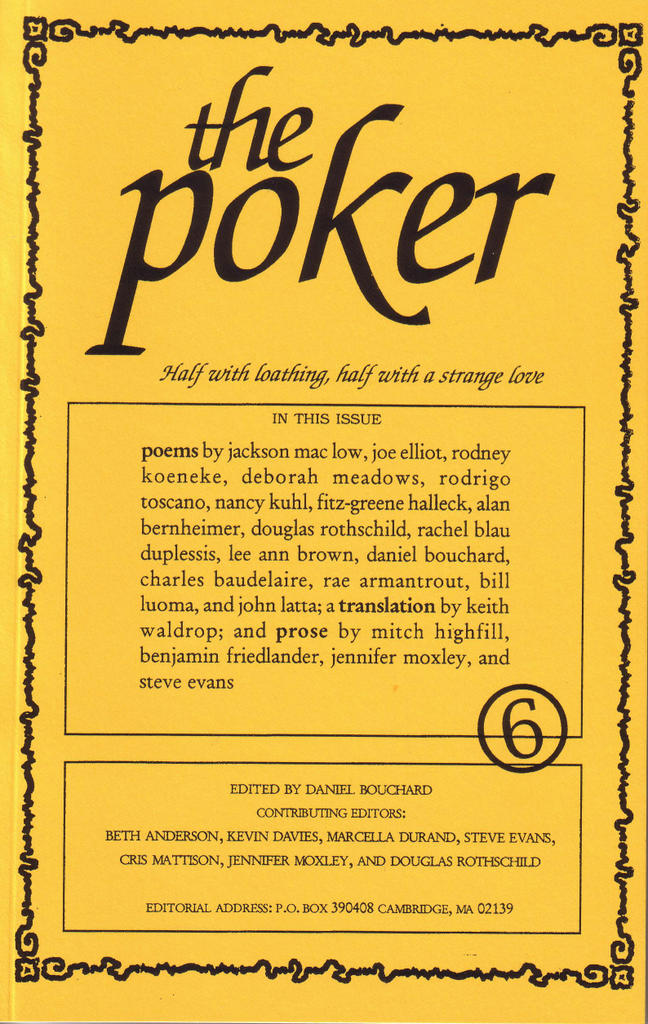
THE POKER, Issue 6. ed. Daniel Bouchard. As always, wonderful. Particularly delightful to read Moxley's discussion of lyric poetry. Poetry by Jackson Mac Low, Joe Elliot, Rodney Koeneke, Deborah Meadows, Rodrigo Toscano, Nancy Kuhl, Fitz-Greene Halleck, Alan Bernheimer, Douglas Rothschild, Rachel Blau DuPlessis, Lee Ann Brown, Daniel Bouchard, Baudelaire, Rae Armantrout, Bill Luoma & John Latta. Translation by Kieth Waldrop. Prose by Mitch Highfill, Benjamin Friedlander, Jennifer Moxley and Steve Evans.
CHICAGO REVIEW, 50: 2/3/4. ed. Eirik Steinhoff. The issue contains essays on Zukofsky by Mark Scroggins ad David Wray, a selection from Zukofsky's correspondence, & Elsa Dorfman's portraits of Zukofsky. Paul Zukofsky discusses the marginalia found in his fathers library as perhaps the last frontier of Zukofsky scholarship. Other work includes poems by Rachel Blau DuPlessis, Theodore Enslin, Tom Pickard, and others, as well as essays & reviews by Daniel Bouchard, Michael Heler, Thomas Fink, Devin Johnston and others. go to their website! Its all there.
Any source
Saturday, October 22, 2005
ANDREW SCHELLING'S TWO ELK (BOOTSTRAP PRESS 2005)
If Andrew Schelling were to do nothing but write and publish notebooks I would be more than satisfied. The notebooks are wonderful, processual journeys which emerge incrementally as the author moves through experience, through the day to day. Two Elk follows much the same loose form as his earlier notebook THE ROAD TO OCOSINGO, moving freely between fragmented bits of prose, verse, letters, recorded dreams, quotes & observations. Schelling himself explains lucidly in his preface:
During autumn of 2003 I kept a high country journal which I eventually named Two Elk after the creek that lies in an adjacent drainage to Vail ski resort's Category III expansion. My project in the notebooks was to document excursions into Colorado's high altitude terrain. These formidable peaks & high valleys--with their low oxygen, scant moisture, intense sunlight, scouring winds, & tough ice--have been my kindest, toughest, & sturdiest teachers the fourteen years I've lived among them. Hence the notebook entries became songs, prayers, and poems of devotion.
Schelling's grasp on the craggy, rugged Colorado wilderness around him is shaped by an impressive knowledge of world literatures, a keen awareness of his position in relation to the totality of the surrounding world. Vedic goddesses, T'ang poets, Scotch sailors & an assortment of others inhabit & inform Schelling's perception of time & space from his point of reference in the foothills of the Colorado Rockies.
At the very core of the work, however, is a deeply-seated understanding of the environment at large, the Earth, as a transient & ecologically delicate thing which must be cherished and preserved. In determining a source of heat for he & his daughter Althea, his decision is ecologically informed:
Harvest days. The gathering of the year. The stacking of fruit & firewood. This year I will take heat only from wood, coal-bed methane extraction being such a disaster. The buried seams crack under pressure, the retort like an earthquake, and noxious gas enters the water table.
Just as the earth is delicate, the same holds true for the human body. It is the transience and fragility of life which we are most aware of in times of adversity, in the cold, & Schelling believes it is this which lies at the center of all things human, of love & of the work which emerges from love:
Late autumn is for melancholy. A fragrance of wet leaf mould stirred with fermenting apples. I have a body that evolved in the Pleistocene & want to burrow under the covers. This is the season for love.
Any source
During autumn of 2003 I kept a high country journal which I eventually named Two Elk after the creek that lies in an adjacent drainage to Vail ski resort's Category III expansion. My project in the notebooks was to document excursions into Colorado's high altitude terrain. These formidable peaks & high valleys--with their low oxygen, scant moisture, intense sunlight, scouring winds, & tough ice--have been my kindest, toughest, & sturdiest teachers the fourteen years I've lived among them. Hence the notebook entries became songs, prayers, and poems of devotion.
Schelling's grasp on the craggy, rugged Colorado wilderness around him is shaped by an impressive knowledge of world literatures, a keen awareness of his position in relation to the totality of the surrounding world. Vedic goddesses, T'ang poets, Scotch sailors & an assortment of others inhabit & inform Schelling's perception of time & space from his point of reference in the foothills of the Colorado Rockies.
At the very core of the work, however, is a deeply-seated understanding of the environment at large, the Earth, as a transient & ecologically delicate thing which must be cherished and preserved. In determining a source of heat for he & his daughter Althea, his decision is ecologically informed:
Harvest days. The gathering of the year. The stacking of fruit & firewood. This year I will take heat only from wood, coal-bed methane extraction being such a disaster. The buried seams crack under pressure, the retort like an earthquake, and noxious gas enters the water table.
Just as the earth is delicate, the same holds true for the human body. It is the transience and fragility of life which we are most aware of in times of adversity, in the cold, & Schelling believes it is this which lies at the center of all things human, of love & of the work which emerges from love:
Late autumn is for melancholy. A fragrance of wet leaf mould stirred with fermenting apples. I have a body that evolved in the Pleistocene & want to burrow under the covers. This is the season for love.
Subscribe to:
Posts (Atom)