Showing posts with label child. Show all posts

Thursday, June 27, 2013

Children, Hot Weather & Cars = Danger!

With 34 child deaths in the United States already this year attributed to children left alone in hot vehicles, the Los Angeles Fire Department is asking for your help:

We need to make sure no child dies as the result of being left alone in a hot vehicle.

It's a problem we can solve together!


  • Always put something you'll need - such as your phone, handbag, a sunshade, lunch or briefcase on the floor in the back seat. This will make you open the back door of your vehicle every time you reach a destination. This way, making sure no child is left behind becomes a habit. Safety experts call this the 'Look Before You Lock' campaign.
  • Keep a large teddy bear in the child's car seat when it’s not occupied. When the child is placed in the seat, put the teddy bear in the front passenger seat. It's a great visual reminder that anytime the teddy bear is up front, a child is secured in a child safety seat behind you!
  • Make arrangements with your child’s day care center or babysitter that you will always call them when your child will not be there on a particular day as scheduled. This is not only common courtesy, but makes sure everyone involved in the care of your child is informed of their whereabouts. Ask these caregivers to always phone you if your child doesn’t show up when expected.
  • If you see a child (dependent adult or pet) alone in a hot vehicle, get involved. If they are hot or seem sick, get them out as quickly and safely as possible. Call 9-1-1 or your local emergency number for assistance as necessary.
  • Never leave your car keys where children can access them, and always make sure your car is locked so that children cannot get in without adult supervision.
  • Do not underestimate a child's capabilities. Teach your children about the dangers of a car, especially the car trunk. Most children can differentiate between a tool and a toy. Make certain they know that a car is not a toy!
Please share word of applicable California law, as well as:


Submitted by Brian Humphrey, Spokesman
Los Angeles Fire Department
Article any source

Tuesday, May 28, 2013

What Parents Need to Know About Child Passenger Safety Seats

Motor vehicle crashes are the leading cause of death and injury for all children. According to our friends at AAA, child restraints (car seats) reduce the risk of injury by 71% to 82% and reduce the risk of death by 28% in comparison to children in seat belts alone. Booster seats reduce the risk of nonfatal injuries by 45% among 4 to 8 year olds.

All vehicle occupants need to be properly restrained by child safety seats or seat belts to prevent injury in case of a sudden stop, swerve or crash. Seat belts and car seats contact the strongest parts of the body, spread crash forces over a wide area, help the body slow down and protect the brain and spinal cord.


Did you know 3 out of 4 car seats are installed incorrectly?

Before you install a car seat, be sure to read both the car seat instruction manual and your vehicle’s owner manual. Also consider having an expert check the seat. The service is free! Though the Los Angeles Fire Department does not presently have certified technicians, locating a nearby expert for your free inspection is as simple as calling (866) SEAT-CHECK or clicking seatcheck.org

The best car seat is one that:
  • Fits your child.
  • Fits the vehicle.
  • And you will use correctly every trip!
Research indicates that safety belts and car seats are the most effective devices in preventing serious injuries and deaths in vehicle crashes. For information on child passenger safety, visit:


Submitted by Brian Humphrey, Spokesman
Los Angeles Fire Department
Article any source

Wednesday, July 4, 2012

Fireworks Injure Several in Southland, Including 3 Los Angeles Children

LOS ANGELES - A series of preventable mishaps with personal-use fireworks sent several Los Angeles residents to the hospital on Independence Day, including at least three children who sustained painful injuries.

Hospitals across the region reported seeing firework related injuries from walk-in patients throughout the day on Wednesday, July 4, 2012; and in at least two separate cases, Los Angeles Fire Department Paramedics provided care to firework injured children under the age of five.

At 9:02 PM, LAFD crews rushed to the 500 block of West 111th Street in South Los Angeles, where a 3-year-old boy was one of two persons in a large crowd injured by illegal fireworks. The boy suffered a significant forehead laceration, while an unrelated 38 year-old man sustained a puncture wound to his leg.

At 9:35 PM, the Los Angeles Fire Department responded to the 2200 block of East 101st Street in Watts, where a 4-year-old girl suffered a sizeable and potentially scarring full-thickness burn to the right side of her neck when as much as 2 percent of her body surface area was impacted by a flaming and outlawed "Roman Candle".

The parents of yet a third Los Angeles area child burned by unlawful fireworks made a frantic 9:27 PM telephone call from their car to 9-1-1 Dispatchers while racing to a local hospital, but did not offer their location, additional details or remain on the line.

The many persons - especially young people, injured by personal-use fireworks in Los Angeles stood in stark contrast to the countless families across the region who safely attended professional displays.

It is important to note that the possession or personal use of any firework has been outlawed in the City of Los Angeles since World War II.


Submitted by Brian Humphrey, Spokesman
Los Angeles Fire Department
Article any source

Thursday, June 7, 2012

Your Firefighters Are Seeking Lemonade... and Hope

As a rule, members of your Los Angeles Fire Department don't carry much money with them while on duty.

This weekend however, that rule may be bent just a little, as the men and women of LAFD make room to pay for a true passion. We're not talking about steak or chocolate cake - we're talking lemonade. But not just any lemonade...

Alex's Lemonade Stand - National Lemonade Days

During National Lemonade Days 2012, Neighborhood Firefighters in Los Angeles will be on the lookout for an Alex's Lemonade Stand. With our soft spot for kids, especially those battling severe illness, we've been deeply moved by Alex's story, and pledge to do our part in fighting childhood cancer, one cup at a time.

We hope you'll join us in seeking, hosting or donating to an Alex's Lemonade Stand near you!

Submitted by Brian Humphrey, Spokesman
Los Angeles Fire Department
Article any source

Monday, May 7, 2012

Firefighters: Help Us Prevent Youth Firesetting

National Arson Awareness Week. Click to learn more...

May 6-12, 2012 is Arson Awareness Week in the United States, with a focus to "Prevent Youth Firesetting" - and for good reason.

Nationwide between 2005 - 2009, "fires started by children playing" accounted for a staggering yearly average of:

  • 56,300 fires
  • 110 civilian deaths
  • 880 civilian injuries
  • $286 million in direct property damage.
In 2010, according to the FBI, 40% of arson arrests were juveniles with 47.6% of those children under 16 years of age.

Parents need to teach young children that fire is a tool, not a toy. Matches and lighters must be kept far out of reach, ideally in a high, locked cabinet. Along with providing constant supervision, adults and caregivers must offer positive examples whenever using fire and fire-starting tools.

Learn more about protecting your family and community from youth firesetting at:

usfa.fema.gov


Submitted by Brian Humphrey, Spokesman
Los Angeles Fire Department
Article any source
Tuesday, December 13, 2011

An Essential Child's Gift Missing From Your List

With holiday shopping at a peak, the streets will soon be full of bike-riding, skateboarding and skate-wearing kids.

While it generally makes us smile to see a child riding a new bike, skateboard or even a pogo stick (yes, they still make them!), there is one thing we are not seeing in your shopping cart.

In a collective rush to get the bike or skateboard under the tree, many have forgotten an essential accessory to go with their child's gift. Namely...

A helmet.

Along with gloves, knee- and elbow pads, many people have overlooked the importance of providing an approved and well-fitting helmet for their child.

And it's not only about bicycles...

California amended its Bicycle Helmet Law to also require children younger than 18 years to wear a helmet when riding non-powered scooters and skateboards as well as roller (and in-line) skates.

When California's law was enacted in 2003, USA Today called it "the toughest child safety helmet law in the country". Firefighters just call it common sense!

Eight years later, some folks seem to be unaware. So we're offering a reminder, as well as some tips from our good friends at the U.S. Consumer Product Safety Commission.

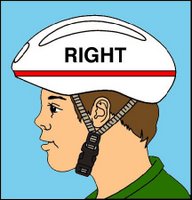
First, make sure you know the correct way to wear a helmet. It makes a big difference.

Helmet worn correctly!Helmet worn incorrectly

The helmet should be worn flat atop the head, not tilted back at an angle. Make sure the helmet fits snugly and does not obstruct the field of vision. Also be certain the chin strap fits securely and that the buckle stays fastened.

Secondly, make sure the helmet you're using is purpose approved. While most helmets appear sturdy, not every helmet is certified for use while bicycling.

We suggest that adult riders set a great example by also wearing a properly fitting helmet at times when they are required for children.

And finally, if you're not sure about the safety of your helmet or other household goods, don't hesitate to check the recall and safety status of helmets, toys and other consumer products by visiting the CPSC website at: CPSC.gov

Having trouble convincing a child to wear a helmet? Just come by the Fire Station. We'll be happy to show them that cool people always wear helmets!


Submitted by Brian Humphrey, Spokesman
Los Angeles Fire Department
Article any source
Tuesday, July 19, 2011

Window Safety: Nine Ways To Keep Your Promise

Home Escape Planning Includes Windows! Click to learn more...Every day you whisper a promise to your child, "I’ll always keep you safe."

But keeping your home and children safe takes more than a promise. It can only be done with planning and preventive action.

The Los Angeles Fire Department joins the National Safety Council and the National Fire Protection Association in asking you to focus today on window safety:

The danger of falls and fire may be greater than you think!

Preventing falls from windows is as important as learning how to use one in an emergency. Unattended children run the greatest risk of fall and injury, so your best 'first step' is to watch children as they play. Nothing can substitute for careful supervision.

Fire is frightening. All too often, the bodies of young children are found after a fire in places where they tried to hide. Teach your children that they can’t hide from fire: They must escape it!

Decide on at least two emergency escape routes from your home. Windows provide one of the fastest, easiest alternative ways out of a burning residence. Teach children how to safely escape through windows and take time to practice with them.

Every family member should know how to operate the windows used for fire emergencies. Delay in escaping fire can cost lives and increase injury. Often paint, dirt or weathering will seal a window shut. Make sure yours open easily from the inside and are not blocked by furniture or other objects.

Remember also that security bars, grilles and grates not only keep intruders out, they can also lock you in. The same holds true for window guards. Everyone should be able to get out through a window at all times without using tools, keys, special knowledge or significant effort.

When youngsters are around, close and latch your windows. If you need ventilation, only open windows they cannot reach. Be sure to keep furniture - or anything children can climb - away from windows. And teach your children not to play near windows.

And finally, never depend on insect screens to prevent falls. Insect screens are designed only to provide ventilation. They will not support the weight of a child or prevent their fall.

Here are 9 simple ways to protect your loved ones:
  1. Windows provide a secondary means of escape from a burning home. Determine your family's emergency escape plan and practice it. Remember that children may have to rely on a window to escape in a fire. Help them learn to safely use a window under these circumstances.
  2. When performing household repairs, make sure windows are not painted or nailed shut. You must be able to open them to escape in an emergency.
  3. Keep your windows closed and latched when children are around. When opening windows for ventilation, open windows that a child cannot reach.
  4. Set and enforce rules about keeping children's play away from windows or patio doors. Falling through the glass can be fatal or cause serious injury.
  5. Keep furniture — or anything children can climb — away from windows. Children may use such objects as a climbing aid.
  6. If you have young children in your home and are considering installing window guards or window fall prevention devices, be aware that the window guards you install must have a release mechanism so that they can be opened for escape in a fire emergency. Consult your local building code
    officials to determine proper window guard placement.
  7. Some homes have window guards, security bars, grilles or grates covering windows. Those windows can be useless in an emergency if they do not have a functioning release mechanism. Test them today because time is critical when escaping a fire.
  8. Do not install window unit air conditioners in windows that may be needed for escape or rescue in an emergency. The air conditioning unit could block or impede escape through the window. Always be sure that you have at least one window in each sleeping and living area that meets escape and rescue requirements.
  9. The degree of injury sustained from a window fall can be affected by the surface on which the victim falls. Shrubs and soft edging like wood chips or grass beneath windows may lessen the impact if a fall does occur.

Can Neighborhood Firefighters count on you?

Along with surveying your home, school and workplace today, please help us by sharing this informative brochure and checklist throughout your community.


Submitted by Brian Humphrey, Spokesman
Los Angeles Fire Department
Article any source