Showing posts with label Environment/Biodiversity. Show all posts

Saturday, July 27, 2013

Wind farm companies warn against wild land ban

Wind industries suggestion for siting restrictions: none

Wind farm companies warn against wild land ban - Telegraph:
Scottish Renewables, which represents the industry, delivered an outspoken attack on additional protections being proposed in response to a public outcry about the spread of turbines across the countryside.
Ministers are considering introducing special safeguards that would make it more difficult to build on wild land, which is defined as being rugged, remote and free from modern visible human structures.
They are also examining increasing the recommended distance between wind farms and the nearest town or village from 2km (1.2 miles) to 2.5km (1.6 miles) and giving greater protection to wildlife.
But Scottish Renewables said the proposed reforms to the planning process would jeopardise £2 billion of investment and Mr Salmond’s plan to generate the equivalent of all Scotland’s electricity from green sources by 2020.
They recommended that there be no blanket protection for wild land ...or areas near towns and villages.
Continue reading at the Telegraph:
Article any source

Sunday, July 21, 2013

Wind farm bird deaths more than thought

New research from the United States indicates that bird deaths from wind farm collisions may have been underestimated by up to 30 per cent.
After the sad death of the White-throated Needletail on Harris, Outer Hebrides, on 26 June when it hit the shaft of a wind turbine on the island, some birders were vocal in their disapproval of the prominent energy generators, proclaiming them to be killers of bird in large numbers. While some of these claims were somewhat exaggerated, it turns out that they may inded be more dangerous than thought previously.
A new study just published in the United States has estimated that around 573,000 birds were killed by wind turbines in 2012 (including 83,000 birds of prey), in increase of 30 per cent on a previous estimate by the US fish and Wildlife Service in 2009. Bats are even worse hit, says author K Shawn Smallwood, and probably top 888,000 killed per year.
Clearly this has serious implications for the renewable energy industry, which bases much of its investment and publicity on the safety and environmental sustainability of the machines. Smallwood also believes his figures are underestimated, owing to the incompleteness if reports of bird and bat deaths from different states, in particular Texas.
Continue reading at Birdwatch Magazine
Article any source

Friday, July 19, 2013

Species at Risk; “Isn't it Ironic...don't you think”

Reading the July 17th press release from David Orazietti, the Ontario Minister of Natural Resources (MNR) announcing a “Species at Risk Stewardship Fund” I immediately thought of Alanis Morrisette's lyrics from her song “Ironic”;
“An old man turned ninety-eight
He won the lottery and died the next day
It's a black fly in your Chardonnay
It's a death row pardon two minutes too late
And isn't it ironic... don't you think”
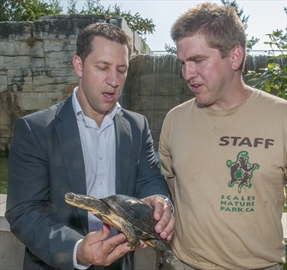
Picture from Hamilton Spectator article
The Minister's announcement appears to have been made in Hamilton at the Royal Botanical Gardens and an article in the Hamilton Spectator of July 17, 2013 carried this quote from Minister Orazietti about the $5 million fund;
"We, Ontarians, care deeply about our environment and our natural resources. That's why we're funding projects by the groups that are here with us today," he said.”
Ironically the story has a picture of the Minister holding a “species at risk” Blanding's turtle. The same Ministry had previously granted Gilead Power the rights to lease “Crown” land at Ostrander Point in Prince Edward County which granted the developer the rights to “kill, harm and harass” birds, bats, alvar (vegetation) and those same Blanding's turtles by giving Gilead the rights to erect 9 industrial wind turbines. That licence caused the Prince Edward County Field Naturalists (PECFN) and the Association to Protect Prince Edward County (APPEC) to appeal the Renewal Energy Approval (REA) in front of the Environmental Review Tribunal (ERT). The appeal was a success and it was the Blanding's turtle that caused the tribunal to advise the Minister of Natural Resources that the REA was rescinded.
Read more »
Article any source

Saturday, July 13, 2013

Ontario's misguided reliance on renwable ‘green’ energy

Maybe The Chronicle Journal (the Newspaper of the Northwest) sometimes prints nonsense in order to obtain high quality responses - such as it displays today.

Living here in Northwestern Ontario, I tried to understand what it might mean to me and Ontario residents in general, if CAPE’s advice is followed in Ontario’s Long-Term Energy Plan Review.
With our decimated industrial user base, power demand the week before the Canada Day weekend in the Northwest was so low, the “old” green power from OPG’s largest regional hydro-electric station on the Nipigon River was caused to shut down and power was purchased instead from politically-in-favour “new” generators at twice the cost.
In Northwestern Ontario, hydro-electric generators, bought and paid for by Ontario taxpayers and electricity consumers decades ago, that can sell power to the grid for 50 per cent of the “new” green generators, are shut. So in future, if more green power is legislated into the grid, will more “old” hydro green energy be curtailed in our region?
CAPE also petitioned the Ontario government to be more aggressive in reducing Ontario’s dependence on nuclear, and even natural gas, to “save lives.”
After the Japanese earthquake and tsunami, Germany, a recognized leader in renewables like solar and wind power, declared nuclear generation verboten. But Germany knows renewables need back-up when the wind don’t blow and the sun don’t shine. So with nuclear being phased out, two new coal-fired plants opened in Germany and six more will in 2013 for a combined capacity of 5,800 MW! And 27 gas-fired plants are in the works.
If CAPE’s statistics on Ontario deaths are correct, then Germany has just condemned hundreds of its people to die and hundreds of thousands to new illnesses.
Read more »
Article any source

Friday, July 12, 2013

Wind Energy Encounters Problems and Resistance in Germany

The German village of Husarenhof, just north of Stuttgart, nestles picturesquely between orchards and vineyards. Peter Hitzker's house stands on a sharp bend in the road.

The Rise of the Monster Turbines | Der Speigel
"Sometimes I get up in the morning and find a couple of totaled cars in the front yard," he says. "But I guess nowhere's perfect."
Still, he finds the wind turbine behind his garden fence harder to cope with. The tower is 180 meters (590 feet) high, and the whirr of the blades and grinding of the actuators are clearly audible.
"When I leave my local bar in Heilbronn, 15 kilometers from here, I find my way home by heading for the turbine," he quips.
But he can't think of anything else positive to say about the turbine. "It's dreadful," he says. "And it's split the village. It's war here."
---
More than 700 citizens' initiatives have been founded in Germany to campaign against what they describe as "forests of masts", "visual emissions" and the "widespread devastation of our highland summits."
The opponents carry coffins symbolizing the death of environmental protection. They organize petitions on an almost daily basis. Local residents by Lake Starnberg have even filed a legal complaint alleging that the wind turbines violate Germany's constitution.
The underlying divide is basic and irreconcilable. On one side stand environmentalists and animal rights activists passionate about protecting the tranquility of nature.
Read the entire article at SPIEGEL ONLINE:
Article any source

Natural exit

The independent local paper on the Ostrander Point tribunal decision, and its implications

Natural exit | The [Wellington] Times:
Forced to look at the energy file in recent months, mainstream media and average citizens have, at last, begun to examine the outlandish claims, empty promises and lucrative deals made in the name of green energy in this province. The more they look, the less they like what McGuinty has done to electricity in Ontario. His dream has become our very expensive nightmare.
Consider that his own Ministry of Environment approved an industrial wind project on Crown Land at Ostrander Point, and that two independent reviewers subsequently concluded it would be ruinous to a species that is already considered endangered. It is astonishing and worrying that McGuinty’s arrogance took us so far down this terrible path without greater public resistance.
But at last that resistance has been stirred. Too late for Wolfe Island. But perhaps not for Prince Edward County. Or Amherst Island.
The Blanding’s turtle buys this community, and others across the province, some time. And time is the enemy of McGuinty’s wrong headed energy policies. They never made a lick of sense to the folks entrusted to run the grid. Nor did they make any sense to folks who, by curiosity or circumstances, paused to examine his plans and methods closely.
McGuinty’s narrative only worked among folks who were hungry for an easy solution to tough global challenges.
Now he is gone and the stench of the mess he left is seeping out across the land. It will linger with us for decades to come. Premier Wynne must now work feverishly to undo the mistakes made by her predecessor, without appearing to be doing so, while retaining a green patina on her government.
Please read the entire article at The [Wellington] Times

Also at the Times:
Missing LinkTribunal fails to connect sickness to industrial wind turbines
RevokedWhy the Tribunal decided it it had to save the Blanding’s turtle
'Right is on our side" | Approval for Ostrander Point wind energy project is revoked by Tribunal

Article any source

Thursday, July 11, 2013

Prince Edward County and their Super Turtles: Renewable Energy Approval overturned

The headline in the Belleville Intelligencer of July 5, 2013 read “Turtles win wind battle”!

Apparently turtles (particularly those of the “Blandings” variety) not only outrace rabbits but they can sway power over lawyers in quasi-judicial positions as the results of the Environmental Review Tribunal (ERT) for the Ostrander Point Wind Energy LP recently disclosed. Despite over 40 days of hearings with numerous witnesses called on behalf of the Prince Edward County Field Naturalists (PECFN) and the Alliance to Protect Prince Edward County (APPEC) it was the Blandings turtle that was the hero to the numerous Prince Edward County residents who opposed the erection of 9 industrial wind turbines at the Ontario Ministry of Natural Resources owned land known as Ostrander Point.

The costs, measured as; harm to humans that might be affected by industrial wind turbines or the rare alvar vegetation didn't play into the decision by the two ERT panel members! As it turned out it was the slow moving endangered Blandings turtle that swayed them to make the first ever ruling against the Ministry that handed out the REA. A huge win, after numerous losses that places the “Blandings” turtle on a pedestal akin to a war hero or an Olympic gold medalist in the 100 meter dash.

The win by this slow moving reptile didn't come cheaply as the efforts by both PECFN and APPEC to raise the funds necessary to sponsor their appeal are measured in the hundreds of thousands of dollars and the appeal to complete their fundraising activities continue, as both try valiantly to close the gap to ensure that Eric Gillespie and his legal team's costs are covered. Read more »
Article any source

Wind power: Government should get it right

This article is from the print edition of the Picton Gazette, July 11, 2013
OUR OPINION
Decision was correct for Ostrander, but still missed mark  
THANKFULLY, the endangered Blanding’s turtle takes up its residence near Ostrander Point and Ontario's Environmental Review Tribunal decided the construction and ongoing operation of industrial wind turbines in that habitat was too significant a threat to its survival to be ignored.
That’s good news, barring appeal, because it takes away a wind project that had the potential to do damage to a lot more than just one species of turtle. The county’s south shore is still an Important Bird Area and it is still located on rare alvar habitat. From testimony the tribunal heard, there is reason to believe the natural environment would be impacted and there are no guarantees even with the best of mitigation methods suggested, that damage would not be done to the many species that live among that habitat. In fact, it would have been nice to see an even stronger message from the tribunal about the potential for that harm so this community can stop fighting internally and stop raising money to wage a similar war over future planned projects.

It also appears the tribunal didn’t go far enough in addressing human health when considering the
impact industrial wind has on those around them.
Read more »
Article any source

Battle over wind turbines in the land of Sleeping Beauty

This quiet, scenic place is a magnet for tourists from all over the world.
But now there are also plans to build up to 200 turbines on the surrounding hills.
Ann-Kathrin Blankenberg is a PhD student and a vocal opponent of the plans.
"It is not because this is the area of Sleeping Beauty," she says.
Image from source article
"I want the green movement, I want green technology, I don't want nuclear power - but they should be made in the right way and not by destroying the forest.
"We have here special, old growth forest and some species just live in this area and are in danger because of the turbines."
The campaigners argue that putting wind turbines in this area makes no sense. The wind speeds are low and the area is home to some extremely rare birds including the endangered black stork.
Across Germany, the plans for expansion have pitted green against green - the potential damage to natural resources from the building of turbines seems to be the biggest concern for opponents.
About 170 regional groups opposed to wind energy have now formed a national organisation called Vernunftkraft, to fight the expansion of turbines. They are trying to get enough signatures on a petition to force the German parliament to debate the future direction of the Energiewende, especially the subsidies for wind energy.
Read the entire article at BBC News

One interesting aspect of the article, given the explorations in Ontario of using Crown land to locate turbines, is the implication turbines would only be located in such a scenic area because the area has been kept under state ownership:
Guenter Koseck, the owner of the castle at Sababurg that is reputed to have been the home of the slumbering princess, says this is not an ideological fight.
"This area is owned by the state, so if we get turbines here only because it is the easiest place to locate them and not because it is the most efficient area, then I would object," he says.

Article any source

Friday, July 5, 2013

Nor'Westers No Place For Wind Turbines

“This site is simply an inappropriate location for an industrial project of any magnitude.” 


“…the Nor’Wester is a unique natural feature, our regions equivalent to the Oak Ridges Moraine or the Niagara Escarpment.” 

“I …. fully support Fort William First Nation, Municipality of Neebing and the broad base of community stakeholders that have worked tirelessly in opposition of this project.”

-Bill Mauro, MPP, Thunder Bay-Atikokan (Liberal)

NetNewsledger.com - Nor'Westers No Place For Wind Turbines:
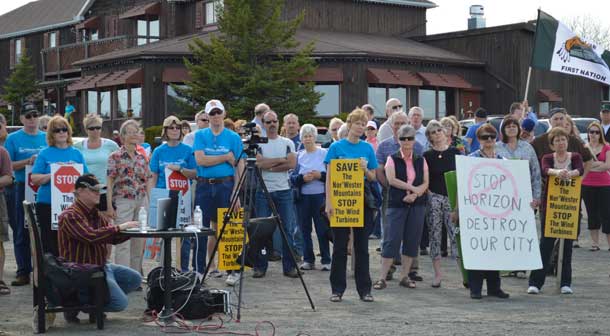
THUNDER BAY – Guest Editorial – Horizon Wind Inc’s Renewable Energy Application (REA) for the Big Thunder Wind Park, was posted by the Ministry of Environment (MOE) for final public comment until June 22nd. The Nor’Wester Mountain Escarpment Protection Committee (NMEPC) has been diligently reviewing Horizon’s REA, commissioning reports, and submitting comments showing the enormous shortcomings of Horizon’s project and the serious negative consequences to our community and the Loch Lomond Watershed. This has serious implications for the residents of Thunder Bay, Fort William First Nation and the Municipality of Neebing.

Image from source article
The NMEPC has been working over the past 4 years since learning of the City’s untendered Option to Lease the 20,000 acres allowing a Toronto developer to erect industrial Wind turbines on the Nor’Wester Mountains and Loch Lomond Watershed. The NMEPC has reviewed and commented on the two previous Draft REA reports, held Open Houses, held monthly Community Meetings, made numerous deputations to City Council and met with numerous government officials to expose the serious consequences should this project proceed. Homeowners and residents are particularly vulnerable as shown by other recently-approved projects elsewhere in Ontario.

Northwestern Ontario has an abundance of remote, ideal locations adjacent to the grid, which could easily accommodate such a development in this region. To destroy an over 100 year protected watershed, a unique maple sugar forest, home to at-risk species, and the traditional uses for First Nations is completely irresponsible and unwarranted.
Continue reading at NetNewsledger.com:


Article any source

Thursday, July 4, 2013

These problems are blowing in the wind: India

The article, credited to "Priyam Bagga in Pune Mirror" indicates some of the behaviour of the industrial wind industry internationally

www.windaction.org | These problems are blowing in the wind:
With 80 per cent of the country's electricity coming from fossil fuels and nuclear energy, renewable sources of energy such as wind-power are becoming essential. However, it seems that this apparently ‘clean' energy has a few dirty secrets as far as the environment is concerned.
According to statistics available with the Centre for Science and Environment (CSE), about 1,100 hectares of forest land has been diverted in Maharashtra alone for wind power projects, which is about 31 per cent of the total forest area for such projects in India.
The heavily forested area of Bhimashankar is under threat due to windmills
Around 45 per cent of all wind power projects in Maharashtra are coming up in forested areas, such as near the Koyna and Bhimashankar wildlife sanctuaries and in the Western Ghats, which have been deemed a World Heritage Site by UNESCO. "Wind power projects are growing and the environmental impact is not being attended to.
The impact can be minimised through afforestation and building check dams but it is not being done," said Chandra Bhushan, deputy director general, CSE. 
Continue reading:
Article any source

Organisations unite to call for enhanced wild land protection | Scotland

Press Release | The Mountaineering Council of Scotland:
In an unprecedented move, as MSPs return to their constituencies for the summer parliamentary recess, eight organisations concerned with conservation, wild land and access to the countryside have jointly issued an open letter calling for greater protection for Scotland’s landscapes.
Leaders of the organisations – The Association for the Protection of Rural Scotland, the John Muir Trust, the Mountaineering Council of Scotland, the Munro Society, the National Trust for Scotland, Ramblers Scotland, The Scottish Rights of Way and Access Society and the Scottish Wild Land Group – between them representing over 350,000 members, welcome moves by the Scottish Government and Scottish Natural Heritage to safeguard Scotland’s landscapes but say that their existing proposals do not go far enough:
“We support the increased protection proposed for National Parks and National Scenic Areas, although this merely formalises the present de facto position.
“Such protection should apply also where development is proposed beyond their boundaries that would impact on the very qualities they were established to safeguard.”

Read more »
Article any source

Wednesday, July 3, 2013

WCO Statement on Ostrander Point Tribunal Decision

The decision in the appeal of the wind power project at Ostrander Point was released late today: while the Tribunal did not accept a causal link to show health effects, they did find for the appellant on the natural environment issue, and determined that "serious and irreversible harm" would occur to the natural environment.

Congratulations to the Prince Edward County Field Naturalists (PECFN), and members of WCO member groups the Alliance to Protect Prince Edward County and the County Coalition for Safe Affordable Green Energy.

PECFN did an amazing job of providing and supporting expert witnesses who told the tale of the unique and rare natural environment at Ostrander Point.

Heartfelt thanks to the the wind power project victims who traveled so far and endured cross-examination in order to get their stories before the Tribunal, which found them to be "credible" witnesses.Their stories will be on the pages of history in this fight for social justice.

Eric Gillespie and his legal team were, as always, elegant and measured.

In the interests of getting this message out quickly, we are sure we have forgotten to mentions someone, but congratulations again to all concerned.

Jane Wilson and Parker Gallant
Wind Concerns Ontario
http://www.ert.gov.on.ca/english/decisions/index.htm
Article any source

Monday, July 1, 2013

Wind farms 'threatening' species

"... the introduction of just 80 turbines is likely to cause the local extinction of Bearded Vultures.”

Bearded Vulture picture from source article
Cape Town - Bird conservationists fear proposed wind farms in northern Lesotho will have a devastating impact on two highly endangered vulture species.
They are the Bearded Vulture – known locally as the Lammergeier, and an iconic species in the Drakensberg – and the endemic Cape Vulture.
Other species that will come under threat from wind farms in the Lesotho Highlands are the Black Stork, Southern Bald Ibis and Lanner Falcon.
Ironically, last week the mountain kingdom was awarded World Heritage Status for its Sehlabathebe National Park in the south-east.
The UN World Heritage Committee that met in Phnom Penh, Cambodia, praised the “spectacularly beautiful watershed area” that hosts flora and fauna of scientific importance and that is home to populations of Cape and Bearded vultures, as well as the endangered Maloti Minnow – a fish species found only here.
Continue reading at IOL scitech:
Article any source

Friday, June 28, 2013

Small island no place for giant turbines

Elizabeth Barr's Opinion article runs in The Toronto Star

Small island no place for giant turbines | Toronto Star:
...The village, farm houses and fields, the winding roads, the stone fences built by Irish settlers, and the extraordinary wildlife have survived. Our ancestors of a century ago would still recognize the island as their home.
Picture (Wolfe Island) from source article
It is very likely that Amherst Island will be transformed into an industrial landscape within the next few years.
A large wind turbine plant is planned for the island and is within months of getting government approval. Such approval is almost certain, given the province’s continued commitment to expediting alternative energy projects. This haste to push projects along has meant that there has been little, if any, planning as to where they should be located, and that people’s serious concerns have been brushed aside.
Read more »
Article any source

Thursday, June 27, 2013

Birdwatchers see rare white-throated needletail fly into turbine on Harris

BBC News - Birdwatchers see rare white-throated needletail fly into turbine on Harris:
Picture from source article
An enthusiast who travelled to the Western Isles to view a rare bird has told of his "dismay" after watching it fly into a wind turbine and die.
The white-throated needletail, which breeds in Asia and winters in Australasia, was spotted on Harris.
About 30 birdwatchers travelled to the island to see the unusual visitor, which has only been recorded five times in the UK since 1950.
However, they then saw it die after colliding with the wind turbine.
Continue reading at BBC News:
Article any source

Green energy job claims are a farce

Lorrie Goldstein continues to call out the Ontario government - and other governments - on job claims

Green energy job claims are a farce | Columnists | Opinion | Toronto Sun:
It’s always good for a laugh when politicians — from U.S. President Barack Obama, to Ontario Premier Kathleen Wynne — brag about green energy as a job creator.
To illustrate, let’s review the number of jobs actually created by the Ontario Liberals’ green energy plan, as opposed to what they promised, while they’ve been sending our hydro bills into the stratosphere.
When ex-premier Dalton McGuinty introduced his Green Energy Act in 2009, he said it would create 50,000 jobs in Ontario by the end of 2012.
But when former auditor general Jim McCarter reported on McGuinty’s green energy plan in December, 2011, he found most of those jobs — 30,000 — were in construction, lasting only one to three years.
Continue reading at the Toronto Sun
Article any source

Tuesday, June 11, 2013

Killing Them Softly: How Wind Turbines Affect Waterfowl Nesting

“We are losing quality wetlands in the Prairie Pothole Region at an alarming rate already... Wind energy might have a compound effect.”

Killing Them Softly: How Wind Turbines Affect Waterfowl Nesting - Wildfowl:
Green energy may be good for the environment, but a growing number of scientists are concerned it may not be for waterfowl. A recent study in the Dakotas is adding fuel to those concerns. It found breeding duck densities were considerably lower around large-scale wind farms compared to wetlands with no turbines in sight.
“We don’t know if the decline is a result of the towers themselves, the motion, noise of the blades, or the increased traffic from maintenance workers,” says USFWS biologist Dr. Chuck Loesch.
“It could be a combination of all those or something else, but that really wasn’t the focus of the study. We wanted to determine if the presence of wind energy development had an impact on duck breeding densities.”
One nesting site had a 56-percent lower breeding pair density than a similar site with no wind turbines.
Continue reading at Wildfowl Magazine (includes comments from Scott Petrie; some specific to Ontario)


Article any source

Sunday, June 9, 2013

David Suzuki Foundation does not support wind turbines in IBA’s

...renewable energy production, like other forms of land use development, can have negative impacts on wildlife habitat and other values, if projects are not planned and sited appropriately on the land base.
Picture on page 27 of 2011 OLP election platform
We are particularly concerned with the proposal by Gilead Power Inc. to establish a wind energy project at Ostrander Point (EBR 011-5239). Ostrander Point falls within the globally significant Prince Edward County South Shore Important Bird Area (IBA) and represents important habitat for migrating and breeding birds in the region. It is a candidate Area of Natural and Scientific Interest (ANSI) and more than 200 different species of birds use the area, including 14 conservation priority species such as whip-poor-wills.
The David Suzuki Foundation believes that careful land use planning is key to ensure that energy production is balanced with the maintenance of wildlife habitat and other important environmental assets. For this reason, we urge you to follow the recommendation by the Ontario Environmental Commissioner to avoid locating new wind energy projects in IBAs, and respectfully ask that you reject the proposed wind development project planned for Ostrander Point given the vulnerability of this sensitive site to harm from development.

Yours sincerely

Dr. Faisal Moola, PhD
Director General, Ontario and Northern Canada
David Suzuki Foundation
The entire letter can be read at SAVE OSTRANDER POINT
Article any source

Wednesday, May 15, 2013

Killing California Condors, and ...

A number of stories cover the threat to species, particularly condors and eagles, from industrial wind turbines
Is the California condor becoming the Obama administration’s albatross?
The Fish and Wildlife Service has given approval for a proposed wind farm in Kern County, Calif., to “take” — that is, injure or kill — one condor over the project’s 30-year lifetime.
That move, the first take the federal government has allowed for the endangered condor, has made odd bedfellows out of wildlife advocates, who say one dead condor is too many, and critics of the administration, who say it shows a bias for renewable energy and against fossil fuels.
The proposal in question — Terra-Gen Power’s 318-megawatt Alta East wind farm — has made some concessions to condor safety that pleased wildlife advocates, including relocating some wind turbines and installing a system that would shut down turbines when radio tagged-condors approach.
But allowing even one condor death is the start of a slippery slope, says Lisa Belenky
Continue reading at Politico
Wind farms get pass on eagle deaths | Associated Press
Read more »
Article any source