症狀/併發症(symptom/complication) | @goiter @Exophthalmic, Ophthalmopathy: Glycosaminoglycan accumulate in external ophthalmic muscle 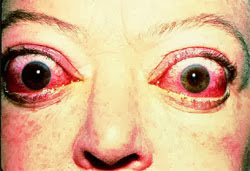 資料來源:aboutcancer @@Class 0: No signs or symptoms @@Class 1: Only signs (limited to upper lid retraction and stare, with or without lid lag) @@Class 2: Soft tissue involvement (oedema of conjunctivae and lids, conjunctival injection, etc.) @@Class 3: Proptosis @@Class 4: Extraocular muscle involvement (usually with diplopia) @@Class 5: Corneal involvement (primarily due to lagophthalmos) @@Class 6: Sight loss (due to optic nerve involvement) @tachycardia  資料來源:維基百科 @pretibial myxedema @dermopathy:Glycosaminoglycan @thyroid bruit(甲狀腺雜音) @thyroid acropachy: clubbing finger  資料來源:clinicalexams @hyperreflexia: hyper DTR than normal |
病因(etiology) | |diffuse thyroid hyperplasia |autoimmune factor: HLA-DR3 |autoimmune antibody bind to receptor and keep T3 and T4 releasing |Stressful life events may be a risk factor |smokers is a risk factor |lymphocyte→INF-γ→fibroblast→glycosaminoglycan |estrogen in female |
檢查/準則(examination/criteria) | histology #colloid absent  資料來源:維基百科 #Functional status: Elevated T3 and T4 #Morphological status: sometimes show goiter #antibody: Anti-TSH receptor antibody #radioiodine uptake: hyperthyroidism will keep high during 24 hours test #Thyroid Ultrasound: combined with color Doppler flow exam--> increased blood: diffuse thyroid enlargement  資料來源:radiopaedia #fine-needle aspiration cytology, FNAC #TSH receptor: 90% of Graves' disease patients have this antibody 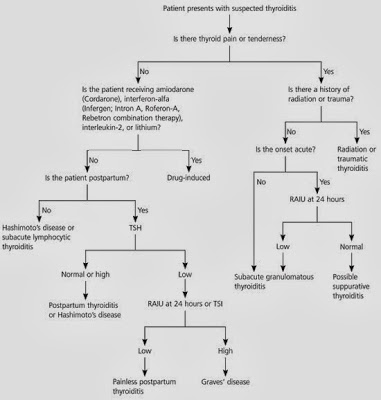 資料來源:aafp |
治療(treatment) | $surgery $radioactive iodine treatment: large doses of 131I- can provide sufficient internal radiation to destroy thyroid tissue $oral anti-thyroid drugs $beta blocker: excess thyroid hormone increases the number of beta receptors in the myocardium, ex: propranolol |
鑑別診斷(Differential Diagnosis) | |
流行病學(Epidemiology) | +most common disease of Hyperthyroidism(甲狀腺機能亢進)//thyrotoxicosis(甲狀腺毒症) +female: male=5:1 +young female 20~40years old is the most +prevalance:approximately 1.3%, increases to 4 to 5% in older women |
HomeAny source

No comments:
Post a Comment